
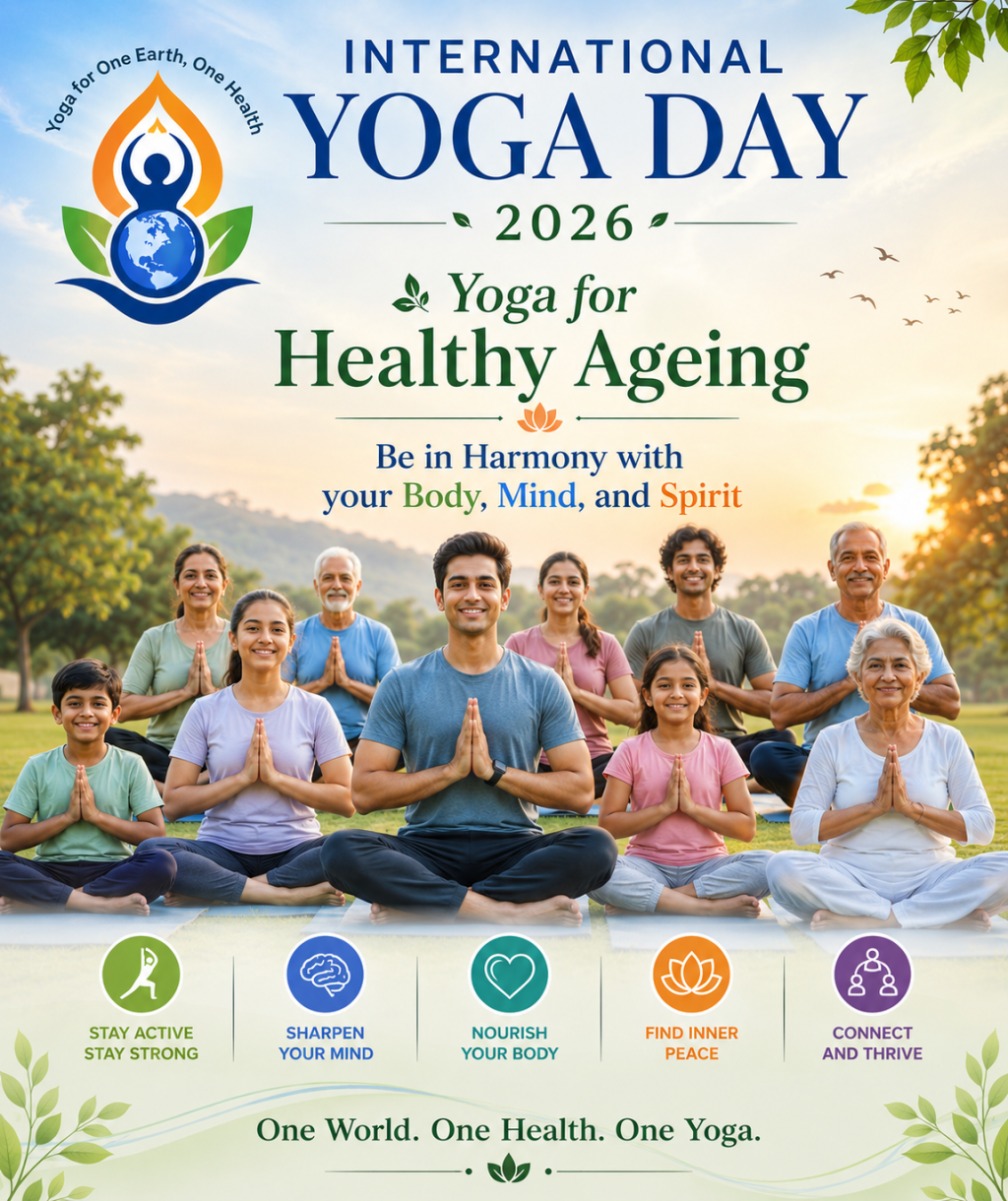
Today, 21st June 2026, the 12th International Yoga Day is being celebrated across the world, and this year’s theme is YOGA FOR HEALTHY AGEING.
Yoga is for everybody and for every generation, including youngsters and older people. Yoga also plays a vital role in the prevention of diseases such as diabetes, high blood pressure, cardiovascular diseases, and other chronic diseases. In this article, we shall explore how yoga promotes healthy ageing.
How Yoga Promotes Healthy Ageing
PREVENTION OF DISEASES
By implementing yoga asanas or yoga postures in our daily life, we can prevent chronic diseases. For instance, when we practice surya namaskar or sun salutation, we are improving our blood circulation, which is beneficial for our heart. When we do twisting postures, we are activating organs such as the pancreas, which controls our blood sugar levels, helping prevent diabetes.
Yoga is also beneficial for our joints, helping prevent arthritis and other related diseases by improving the circulation of lubricating fluids in our joints. Moreover yoga helps to manage our weight hence decreasing the risk of obesity.
KEEPS THE BODY STRONG AND FLEXIBLE
Practicing yoga helps to activate the muscles in our body, including abdominal muscles, biceps, triceps, quadriceps, hamstrings, spine, obliques, among others, keeping our body strong. When we age, we start losing muscle mass, and yoga helps maintain it.
Furthermore, yoga improves balance and coordination. Practicing postures like the palm pose, tree pose enhances our balance, and neuro muscular coordination. Doing a few postures such as the cobra pose and plank pose helps build strength in the body.
COUNTERACTS SEDENTARY LIFESTYLE
Nowadays, a lot of jobs involve working on a laptop and sitting for long hours. However, this sedentary lifestyle causes a lot of health issues like back pain, neck and shoulder pain, wrist pain, obesity, and heart issues due to lack of movement. Screen time has also increased drastically over the last few years.
Chair yoga or corporate yoga has already been introduced in workplaces, aiming to improve employees’ mobility and overall health. Regular breaks and movement are also encouraged to counteract the effects of sedentary lifestyle.
STRESS REDUCTION
Stress, if not managed can lead to health issues such as anxiety, insomnia, depression, or even suicide. Practicing pranayama or yogic breathing techniques such as nadi– shodhana alternate nostril breathing or bhramari humming bee activates our para-sympathetic nervous system which is our rest-and-digest mode. Intentional breath retention known as kumbhaka is also practiced to stabilize our nervous system.
Through our breath, we can calm our nervous system and decrease the stress hormone cortisol. Meditation or dhyana is also practiced to calm our mind, find clarity, and reconnect with our inner self, leading us towards peace, calmness, and liberation.
KEEPS OUR MIND HEALTHY
Through practicing dhyana or meditation, we keep our mind healthy as it improves our memory, brings clarity, and improves our decision-making process. We are living in a highly stimulated world led by artificial intelligence, where our mind is unable to quiet down with all the noise. Yoga is defined as the stilling of the mind.
Meditation teaches us to be in the NOW. In doing so, the mind becomes still and we are able to witness our mind, returning to our inner self.
AYURVEDA
Ayurveda known as the science of life, is a part of yoga which focuses on our nutrition, herbal remedies, lifestyle practices tailored as per our unique body type. It states that we are all made of five elements: space, air, fire, water, and earth.
Each body is a combination of different life forces or doshas: Vata (space and air), Pitta (fire and water), and Kapha (water and earth). The aim of Ayurveda is to bring balance to these elements.
YOGIC PHILOSOPHIES
Yoga does not consist of only asanas, pranayama, or dhyana, but also offers important philosophies to lead a balanced and healthy life.
Karma yoga explains the path of action and service without attaching ourselves to the outcome. Bhakti yoga teaches us to lead a path of devotion and love towards ourselves and others. Jnana yoga is the path of knowledge, wisdom and self-study. Raja yoga defines the path of meditation and liberation.
My Final Reflection
Yoga is for every generation, and the earlier a person starts to practice yoga the better it is. In the long run, yoga offers many benefits; however, it is important to maintain consistency.
How we live our life in our younger years will determine our health as we get older. Yoga is a way of life that I believe we must implement into our daily life. The key is to start slowly, even if it is just fifteen minutes per day.
I believe it is also important to introduce yoga to the younger generations so that they continue the practice as they grow older. Yoga plays a crucial role in the prevention of chronic diseases.
Let us all come together to practice yoga for a healthy, balanced, and peaceful world.
HAPPY INTERNATIONAL YOGA DAY 2026 🧘♀️ YOGA FOR HEALTHY AGEING
Yashna Veera, Life Coach and Yoga & Meditation Practitioner
NIRVANA


Leave a Reply