
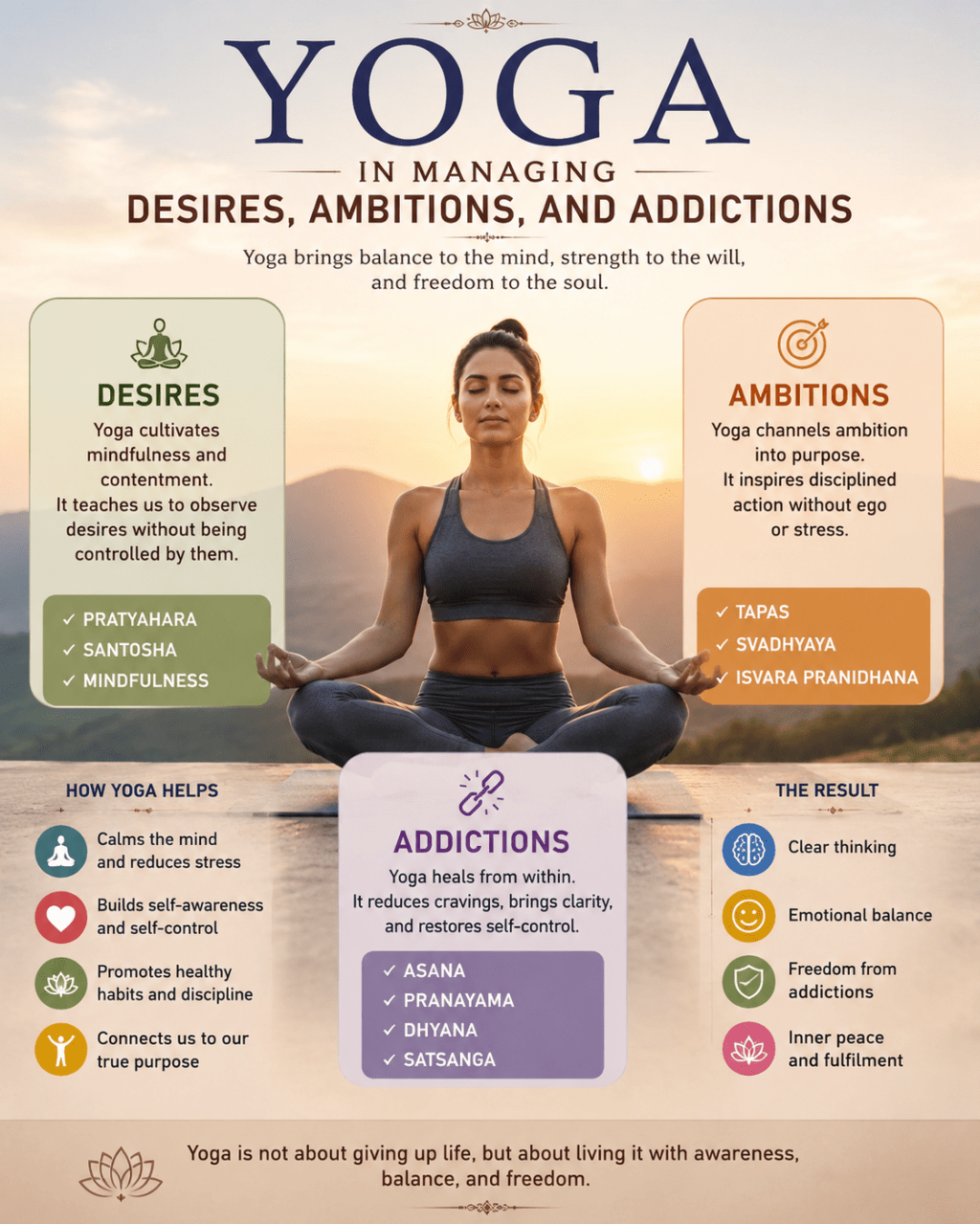
We are living in the 21st century in an AI driven, materialistic, and fast-evolving world. Each one of us has desires, ambitions, and addictions but what happens if we identify ourselves with our desires or ambitions? Obsession, greed, feeling superior, insecurity, power, and wars happen.
Desires, ambitions, and addictions are what we seek externally while yoga teaches to dive internally. That is where yoga can help us. Yoga can help us to manage our desires, ambitions, and addictions while keeping us grounded. In this article, we shall explore how yoga does that.
The Mind and Desire
The mind always seeks desires. When one desire is fulfilled, another desire will start. A person might desire for the latest phone, car, clothing, promotion, more money, more power. While desire is important for survival, it can become destructive if not managed.
Desire begins with a dopamine spike affecting the brain’s reward center pushing us to take action. When that desire gets fulfilled, endorphins are released providing a sense of relief.
Desires somehow trick the mind that joy is found externally. Even a person who has a desire for power is actually seeking external validation. Yoga teaches us to reach for our joy internally meaning our inner self and that is true liberation or moksha.
How Yoga Helps to Manage Desires and Ambitions?
Desires are fueled by dopamine hikes however yoga boosts dopamine naturally and calms the nervous system. Yoga builds awareness, through breathwork and meditation, making us become aware of our desires.
Breathwork or pranayama helps to calm our mind by activating our parasympathetic nervous system and through meditation we become a witness of our own mind.
When we practice meditation, we are also withdrawing from our senses known as pratyahara. The modern world is driven by external stimuli, notifications, and external noise while meditation teaches us to go inward.
Yoga adopts the concept of non-attachment or vairagya meaning not attaching ourselves to the outcomes. It teaches us to do what we have to do but without expectations, ego, or concentrating on the fruits of our actions.
Moreover, through meditation, yoga helps to cultivate contentment known as santosha which drives gratitude and diminishing a sense of lack or comparison.
Yoga teaches us about self-discipline or tapas, self-study or svadhyaya, and surrendering to the divine known as ishvara pranidhana.
In doing so, you no longer identify yourself with your desires or ambitions because you become connected to your inner self which does not depend on external desires or achievements.
How Yoga Helps to Manage Addictions
Addictions can be of different kinds – drugs, alcohol, power, money, lust, etc. The dopamine hike arising from a substance or behavior affects the brain’s natural reward centre. Furthermore, addiction rewires the neural pathways and also affects our prefrontal cortex which is responsible for decision making and impulse control.
Several studies have reported the beneficial impact of yoga on brain’s reward centre, stress management, and inhibitory control. Studies have found that meditation such as yoga nidra resulted in an increase endogenous dopamine release.
Research is now being conducted with regards to the use of yoga in the management of drug addiction. In Mauritius, more youngsters are being affected by drugs including synthetic drugs. Will the regular practice of yoga and meditation help to manage drug addiction and even prevent it? I believe so.
My Personal Observation
Since I have started to practice pranayama (breathing techniques), yoga postures, and meditation, I have noticed changes such as lesser cravings, more controlled desire, and a calmer mind.
A FUNNY ANECDOTE
Before starting my 200-hour yoga course, I used to have a craving for almond milkshakes with whipped cream on top. Sometimes, I used to have it once a week but then that craving became more frequent. When I reached around one month into the yoga course, I passed by the coffee shop and I did not have any craving and that felt weird like there was something wrong with me.
Actually, it was my brain’s reward center which was becoming more regulated. I started to notice many things like this in my life. My desires became like a benchmark to me. If I feel that my desires are becoming too intense or obsessive, I see it as an indicator that I need to go a bit deeper in my yoga and meditation practice.
When I would go deeper in my practice, the obsessive thoughts about that desire would fade, bringing calmness to my mind.
How To Integrate Simple Yogic Practices?
First of all, start small but remain consistent. For instance, you can start with a 15 minutes of practice by doing 5 minutes of breathwork or pranayama like alternate nostril breathing. Then, you can do a few yoga postures like child pose, cat and cow pose, cobra pose, and savasana for 5 minutes and end with a 5 minutes meditation or yoga nidra.
You can do it early in the morning or if you prefer at night as per your preferred schedule.
My Final Reflection
Desires, cravings, and addictions are driven by external needs while yoga brings us inward to our true essence. In doing so, we become emotionally regulated, resilient, and grounded in our own self. Like the lotus, we remain grounded because we are no longer defined by external drives.
Yoga is a continuous practice and pathway of self-discovery. Nowadays, we are quite distracted with external stimuli which is why the yoga practice becomes even more important. That is also why real yogis often disconnect from the material world and prefer living in the Himalayas. Since we live in the modern world, it is important to find that balance.
Observe your desires, ambitions, and addictions and ask yourself what is actually driving them?
Yashna Veera, Life Coach and Yoga & Meditation Practitioner
NIRVANA


Leave a comment